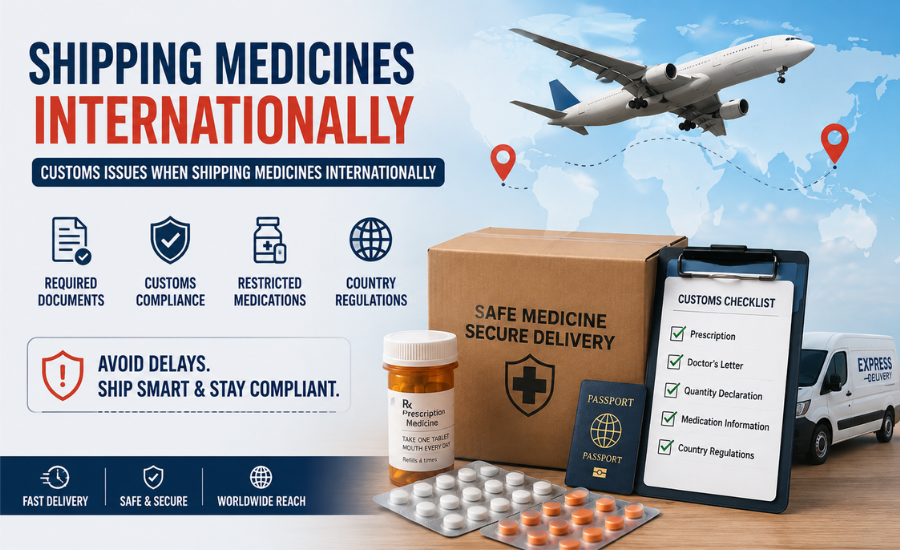
Missing prescriptions, incomplete paperwork, restricted ingredients- that is what causes most delays. Shipping medicines internationally usually gets held up over one of these three problems, not bad luck. Here is a real look at the common customs issues when shipping medicines internationally, and what actually helps a shipment clear without dragging on for weeks.
Why Do Customs Delays Happen When Shipping Medicines Internationally?
Because medicines sit in a stricter category than most shipped goods, and customs officers check them more closely than a regular parcel. Shipping medicines internationally runs into rules that shift from country to country, which is exactly where most of the confusion starts.
A few reasons come up again and again.
- Missing or unclear prescription documentation
- Medication not approved for import in the destination country
- Quantities that go past personal-use limits
- Packaging that does not match customs labeling rules
Knowing these triggers ahead of time saves a lot of back-and-forth once a package is already stuck in transit.
What Documentation Issues Come Up When Shipping Medicines Internationally?
Missing or outdated prescriptions cause more holds than almost anything else. Shipping medicines internationally without a valid, current prescription is one of the fastest ways to get a package flagged at the border.
- Prescription not matching the patient's name on the shipment
- Doctor's details missing or too messy to read
- No English translation attached for non-English prescriptions
- Prescription dated too far back to still count as valid
Keeping paperwork current and clearly matched to the shipment stops most of these holds before they even happen.
Which Common Customs Issues When Shipping Medicines Internationally Involve Controlled Substances?
Controlled substances get watched the closest out of any medicine category, and a lot of seizures trace back to labeling nobody bothered to double check. Dig into most common customs issues when shipping medicines internationally, and narcotic or psychotropic classifications show up again and again as the root cause.
A permit that is missing, an ingredient that is fine at home but banned somewhere else, a declaration form filled out halfway, an import license nobody applied for in time. Any one of these is enough to get a shipment pulled and held for review, sometimes for weeks rather than days.
Pulling up the destination country's controlled substance list before shipping heads off most of this trouble before it ever starts.
How Do Quantity Limits Affect Shipping Medicines Internationally?
Most countries cap what counts as personal use somewhere around 30 to 90 days' worth of medication. Go past that number while shipping medicines internationally, and customs tends to pull the package for extra review, even when the medicine itself is completely routine.
Personal shipments generally need a valid prescription and have to stay inside that 30 to 90 day window to avoid extra scrutiny. Commercial shipments play by different rules entirely, since limits shift with the license involved and usually need a full import permit attached. Controlled substances sit on the strictest end of the scale, often requiring special authorization no matter how small the quantity actually is.
Looking up the exact limit for wherever the package is headed keeps it from getting flagged for crossing a personal-use threshold nobody checked in advance.
What Labeling Requirements Matter for Shipping Medicines Internationally?
The label has to spell out the medicine name, dosage, and active ingredients clearly enough that customs can verify it without slowing down. Vague or half-finished labeling on a shipment tends to trigger manual inspection, and that is where delays really start piling up.
Generic and brand names should sit together on the label wherever that applies, with active ingredients spelled out plainly rather than buried in fine print. The expiry date needs to stay visible and easy to read, and the label itself has to match whatever language requirements the destination country sets, not just the shipper's home language by default.
Clear labeling moves inspection along faster and cuts the odds of a package getting set aside for a second look.
How Can You Avoid Common Customs Issues When Shipping Medicines Internationally?
Get documentation ready early and check the destination country's rules before the package ever leaves. Most common customs issues when shipping medicines internationally come down to groundwork nobody did in advance, not anything unavoidable.
- Confirm the medication is actually legal in the destination country
- Gather a current, clearly written prescription ahead of time
- Check quantity limits specific to that country
- Use a courier that already knows medical shipments well
A bit of preparation upfront saves days of delay once the package is sitting at a customs checkpoint somewhere.
Where Can You Get Help Shipping Medicines Internationally?
Specialized couriers who already know pharmaceutical shipping rules can guide the paperwork and cut down the risk of a customs hold. Running a shipment through a general courier service instead of a medical specialist usually means more delays, not fewer.
A provider like International Medicine Courier works specifically with medicine shipments and whatever requirements each destination country sets. Getting guidance before shipping beats trying to untangle a hold after the package is already stuck somewhere.
Frequently Asked Questions
1. Can I ship prescription medicine to any country?
No, some countries restrict or ban specific medications regardless of a valid prescription.
2. How long can customs hold a medicine shipment?
This varies widely, though incomplete documentation often causes the longest delays.
3. Do all countries require a prescription for shipped medicine?
Most do, though requirements around format and translation vary by country.
4. What happens if a shipment exceeds personal-use limits?
It may be seized, returned, or require additional permits before release.
5. Is it safer to use a specialized medical courier?
Yes, specialized couriers are generally more familiar with country-specific documentation requirements.
Follow us on Facebook and Instagram for more updates, medicine shipping tips, and international courier guidance.